Honest degradation over fake coverage
Canadian and Mexican sources are registered and gated, shown as prepared — not quietly claimed as live. When a source fails, the UI says so and shows what remains.
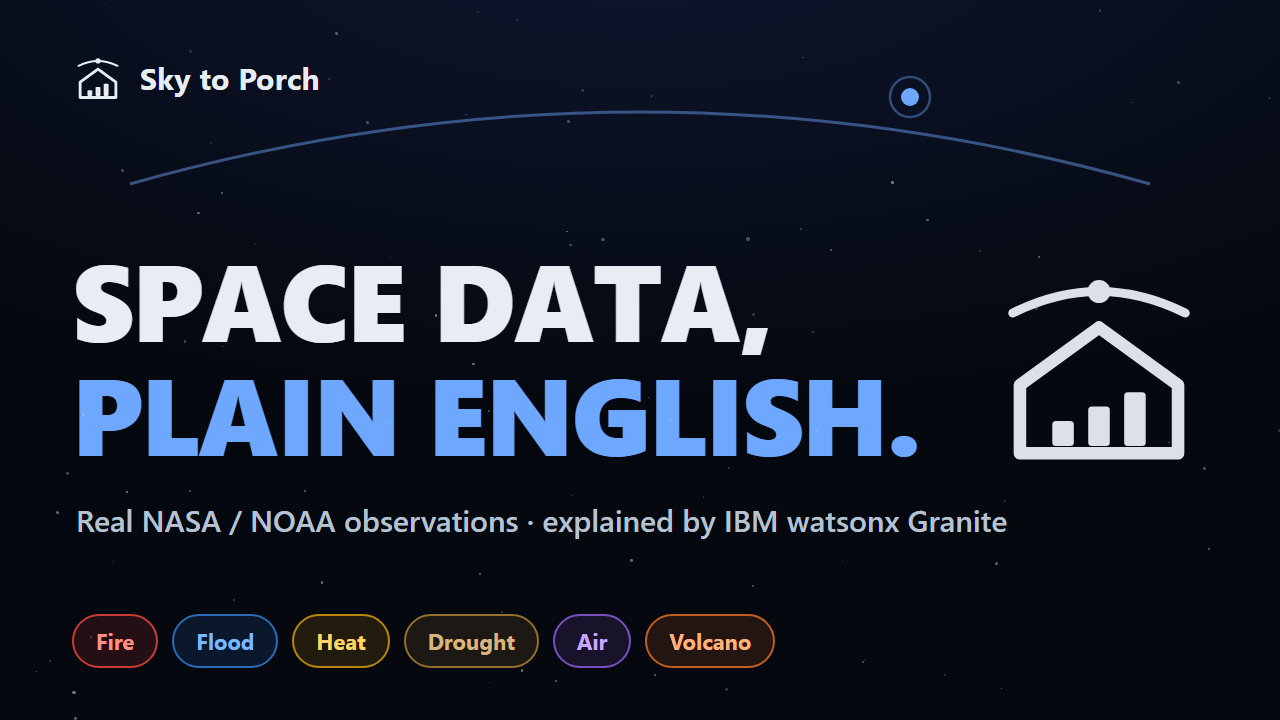
Real NASA and NOAA observations about hazards — fire, flood, heat, drought, air, volcanoes — explained in plain English by IBM watsonx Granite, and engineered so the AI cannot lie about them.
IBM watsonx Granite · 16 Live Data Sources · Evidence Guardrails · Next.js · Live Product
DownlinkThe Demo
The demo walks the whole journey — picking a real event, watching the evidence pipeline retrieve and validate, and reading a Granite answer that traces back to real observations.
Or skip the video and ask it something yourself — it is live.
35,786 kmThe Data
Fire detections, flood imagery, surface temperature, air quality — NASA, NOAA, USGS and EPA publish all of it, every day. But it is published for scientists, not for the people standing underneath it: raw scientific products, coordinate systems, jargon. People without a science background have no clear way to use any of it.
Their questions are concrete. After a storm damages your roof, an insurance claim goes better with real records of what happened at your address. On a very hot day, you want to know whether it is safe to walk your dog. Before a trip, you want to know what the air was like where you are going.
Asking a general chatbot gets an answer — a confident one, with no data behind it. And with hazards, a made-up answer is dangerous in both directions: a false alarm causes panic, and false comfort leaves people unprepared. That asymmetry became the design brief.
705 kmWhat I Built
Sky to Porch asks for three things: where, what hazard, and what matters to you — home, health, pets, travel, power, community. No GIS skills, no API keys, no jargon. Six one-tap demo stories cover real events, from Hurricane Beryl in Houston to the 2023 smoke episode in New York.
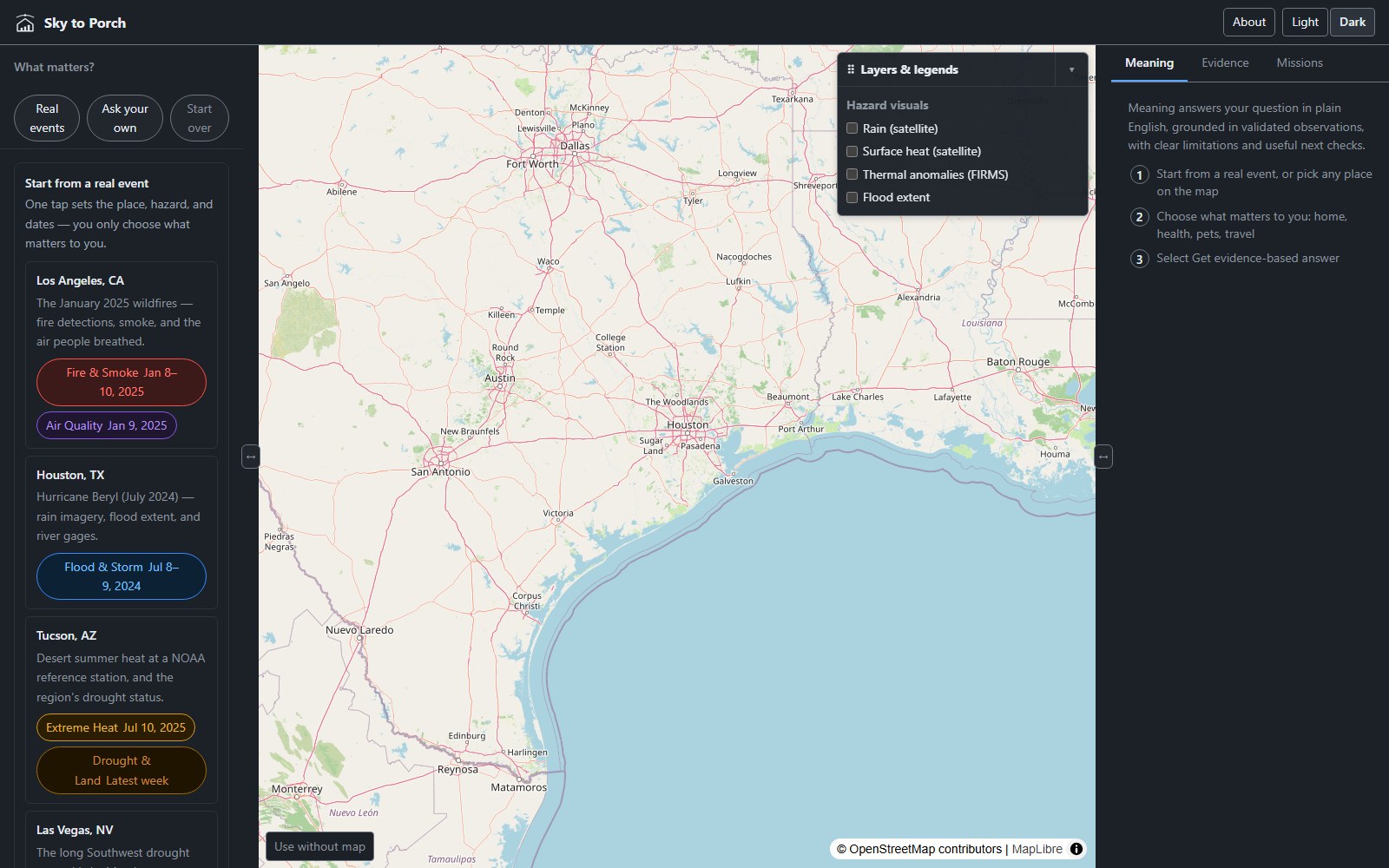
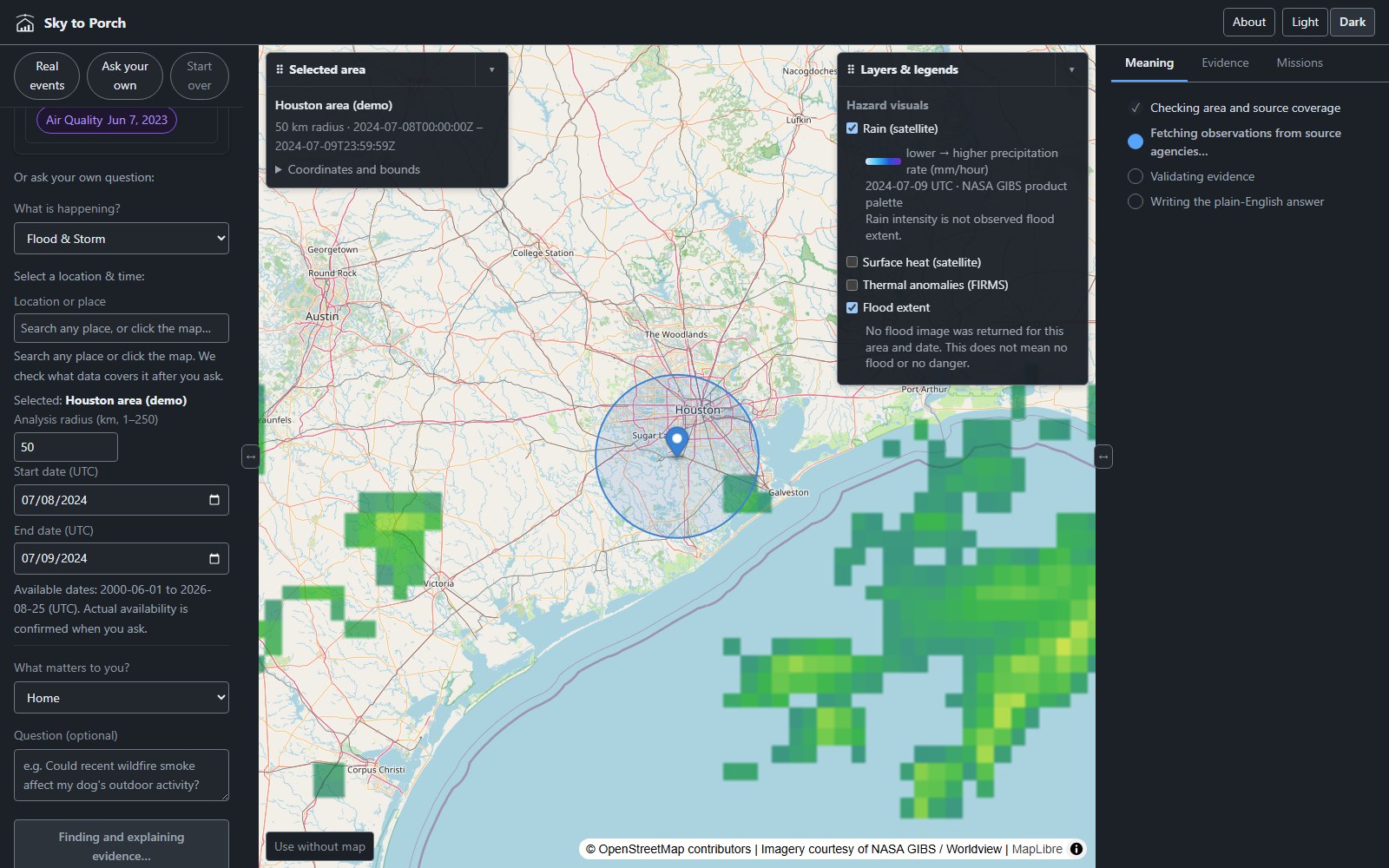
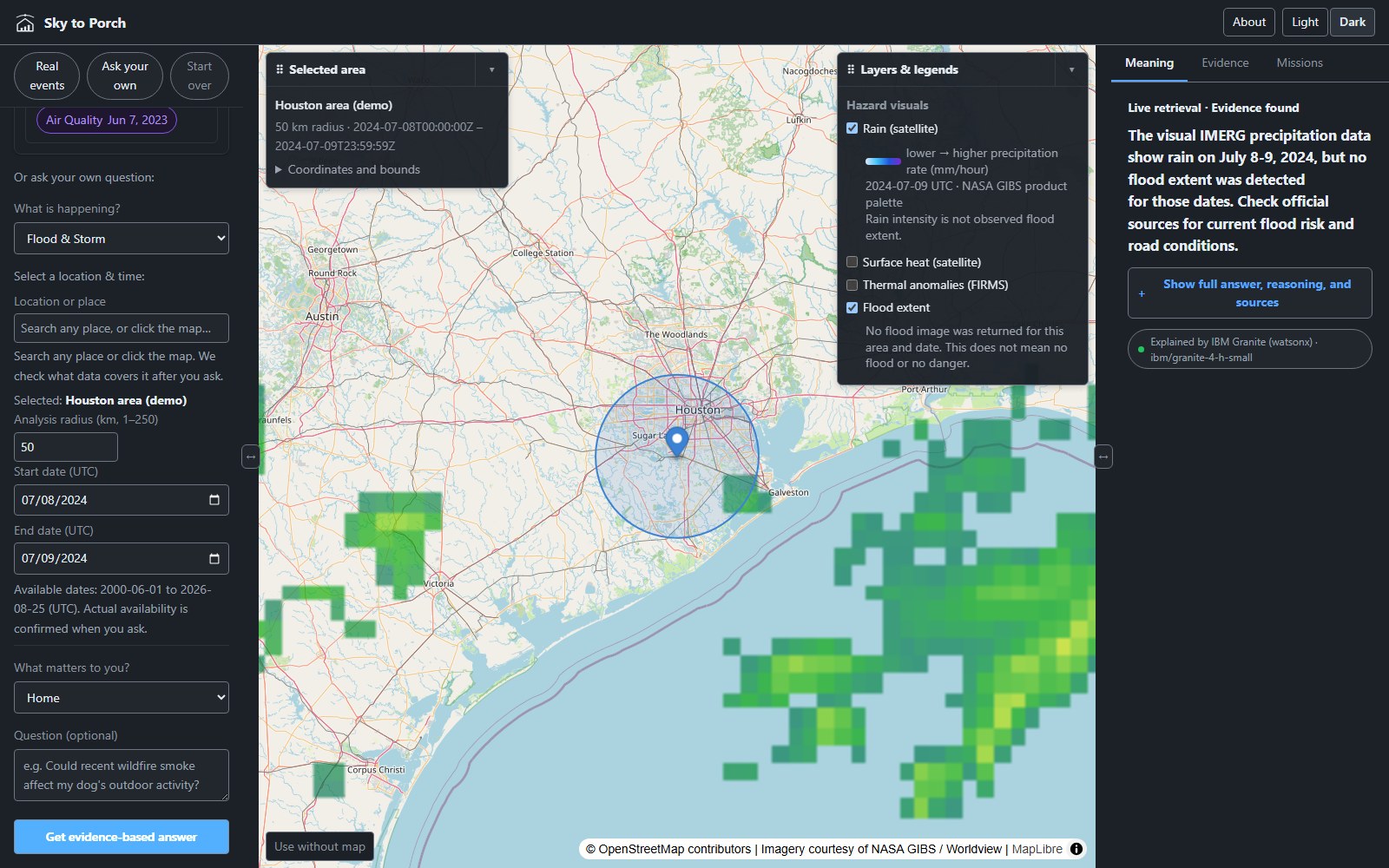
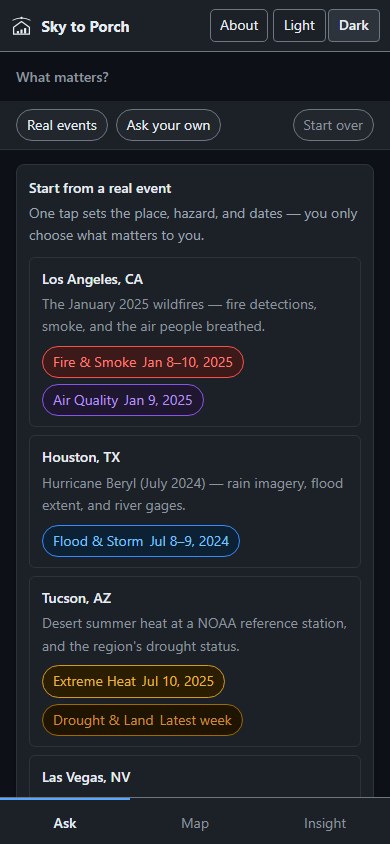
Every answer carries its provenance on its sleeve: a badge names the model that wrote it, every number traces to a validated observation, and each source links the official checker where you can verify it yourself.
400 kmMission Control
Built for the AI Builders Challenge with IBM Bob, this was my largest AI-directed build yet — and the most disciplined. Every architecture decision became a numbered record (ADR-0001 through ADR-0055), so nothing rested on "the model said so".
Explored the problem space, pressure-tested the concept, and helped shape the six-hazard scope before any code existed.
The primary development tool: dataset registry, all six evidence adapters with fail-closed transports, the interpretation layer, AI router and guardrails, the query flow and map.
Code review, prompt writing, part of the verification work, and the stage closeouts that kept 14 work packages honestly finished rather than merely merged.
Final-phase project review and polish, the security hardening of the paid AI endpoints, and the verified production deployment on Vercel.
My constant role across all four stages: product owner, designer, and quality gate — the concept, the UX direction, the honesty rules, and every accept or reject decision were mine.
100 kmThe Kármán Line
A single LLM asked about hazards will confidently invent numbers. Sky to Porch draws a hard line: deterministic code interprets the evidence, and the AI only phrases what has already been proven.
Satellite imagery and ground-station records for the exact area and date. Every source carries a machine-readable coverage profile; a timeout or size overrun ends as a stated failure, never a quiet default.
Validated numbers become structured conclusions — a station's peak heat index becomes an official NWS severity category. The same evidence always produces the same conclusion.
Granite receives conclusions to phrase, not raw data to interpret — which is what keeps the numbers real and the tone human. A labeled OpenAI fallback covers provider outages.
Any number not in the evidence, any invented URL, any unsupported claim is rejected — the offending sentence is replaced by deterministic text and the reason is logged. Safe prose survives.
Two fallbacks, two reasons: provider fallback (watsonx to OpenAI) is availability insurance; deterministic fallback — a real answer with real numbers, no AI at all — is honesty insurance.
Claim separation: what a source shows is stored apart from what it proves. A smoke polygon is smoke analysis, not the air in your lungs — and "no observation" is never rendered as "no danger".
Canadian and Mexican sources are registered and gated, shown as prepared — not quietly claimed as live. When a source fails, the UI says so and shows what remains.
Satellites cover everywhere and prove little about one street; ground stations prove a lot about one point and cover almost nowhere. Showing both, clearly labeled, is the honest option.
A live query takes ten to twenty seconds. Instead of a spinner, the panel shows the pipeline's real stages — the wait itself becomes a proof of work.
One station or one satellite pixel is never offered as proof about one building, person, or pet. Answers name their real scale, and the analysis radius is always visible.
10 mThe Guardrails
The last two architecture decisions before launch were pure defense. An audit of all twelve API routes found one unguarded paid endpoint — it was deleted, not patched. Then the rate limiting moved off the server's memory entirely:
Deployment day proved the design: the first production build went live before its environment variables existed — and the app did exactly what it was built to do: served real evidence, spent nothing, and said honestly that AI was not configured.
1 mField Notes
This project was built in collaboration with AI; the design decisions, content, and direction are mine. I did not write it line by line — I directed four tools through distinct stages and owned the quality bar throughout.
0 mThe Porch
Sky to Porch shipped as a deployed, rate-limited, security-verified product before the AI Builders Challenge deadline — 1,780 automated tests, six live hazard lines, and a browser-verified production rollout.
Next: coverage beyond the United States, and more languages — starting with Spanish and Traditional Chinese, because hazard information is hardest to reach exactly where English is not the first language. The mission fits on its own tagline: real data, honest answers, for the people who live under this sky.
Try the live app, watch the demo, or read the code.