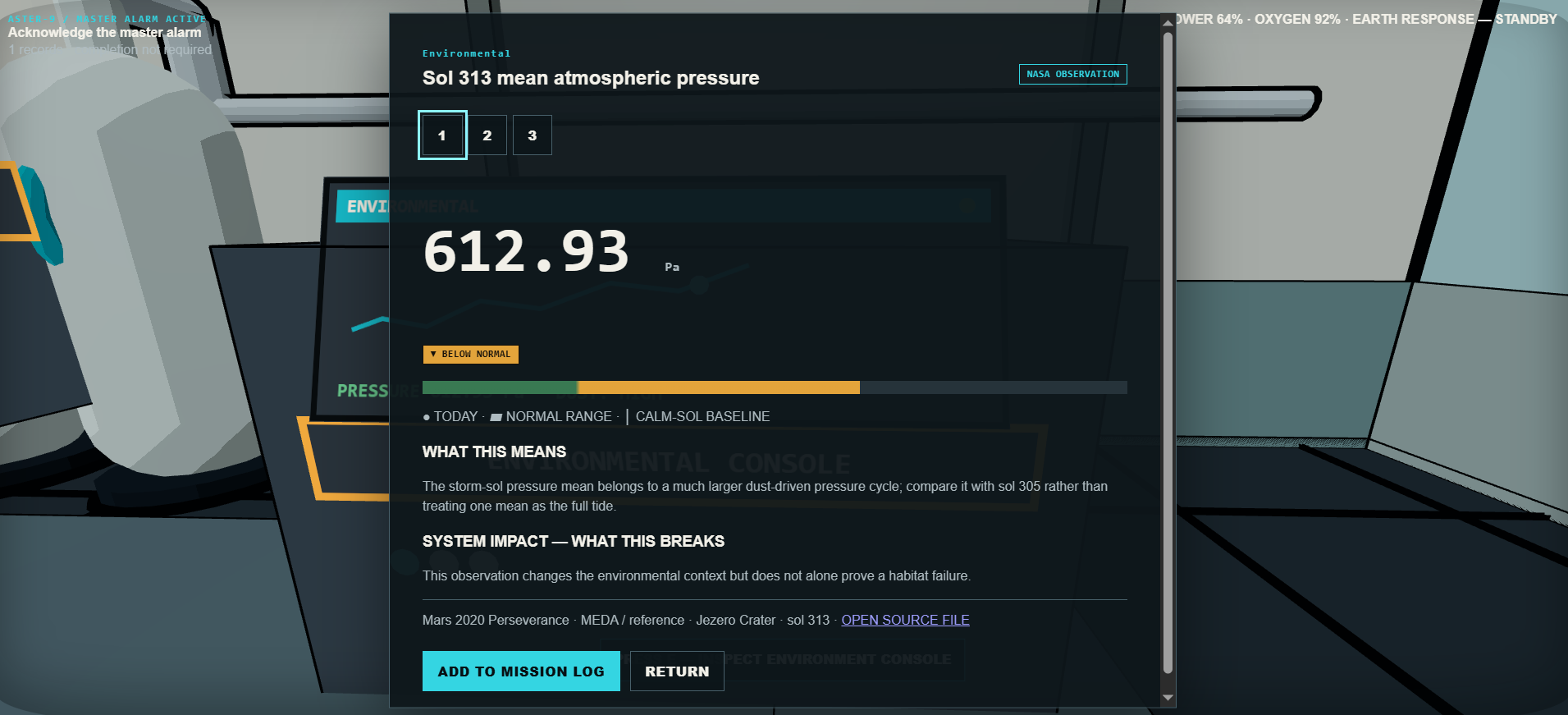
Measured in the selected MEDA record
Reviewed pressure, air-temperature, and wind values keep source ids, original units, transformations, and checksums.
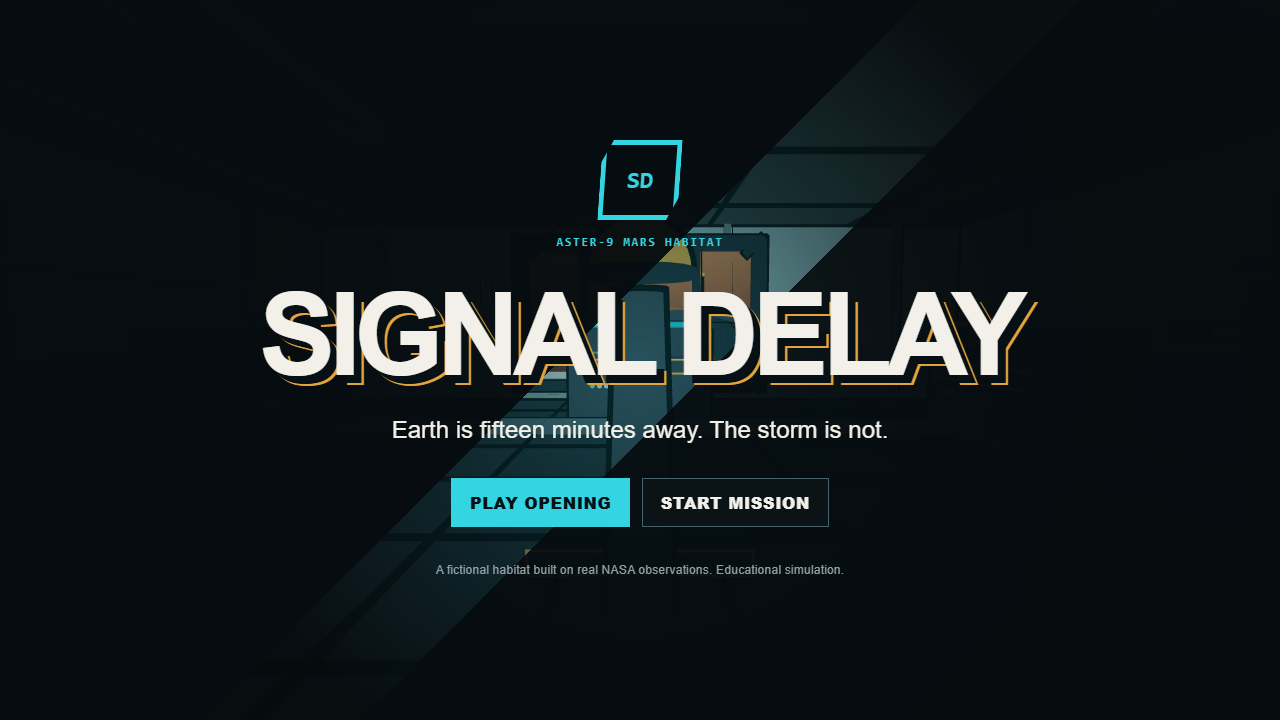
A browser-based Mars mission where real NASA observations become evidence for a decision. Students explore, decide what to trust, and defend a plan in their own words; GPT-5.6 critiques the reasoning while deterministic code keeps control of the facts.
Next.js 16 · React Three Fiber · Rapier · NASA MEDA · GPT-5.6 · OpenAI Responses API
The Problem
NASA publishes extraordinary planetary data. For a high-school or introductory-college learner, though, a specialist archive can be hard to translate into action. A passive article can explain the facts, and a quiz can test recall, but neither necessarily asks the learner to decide what matters under uncertainty.
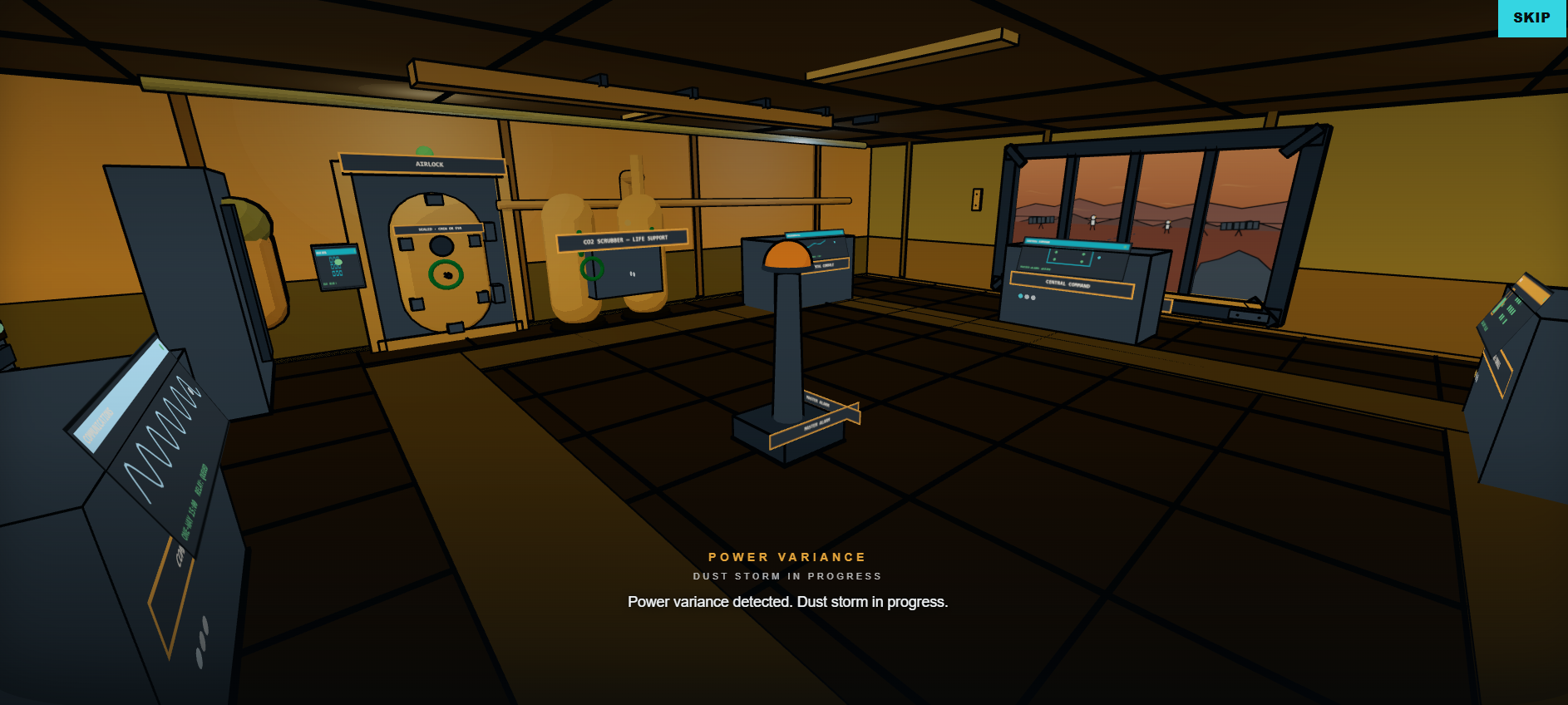
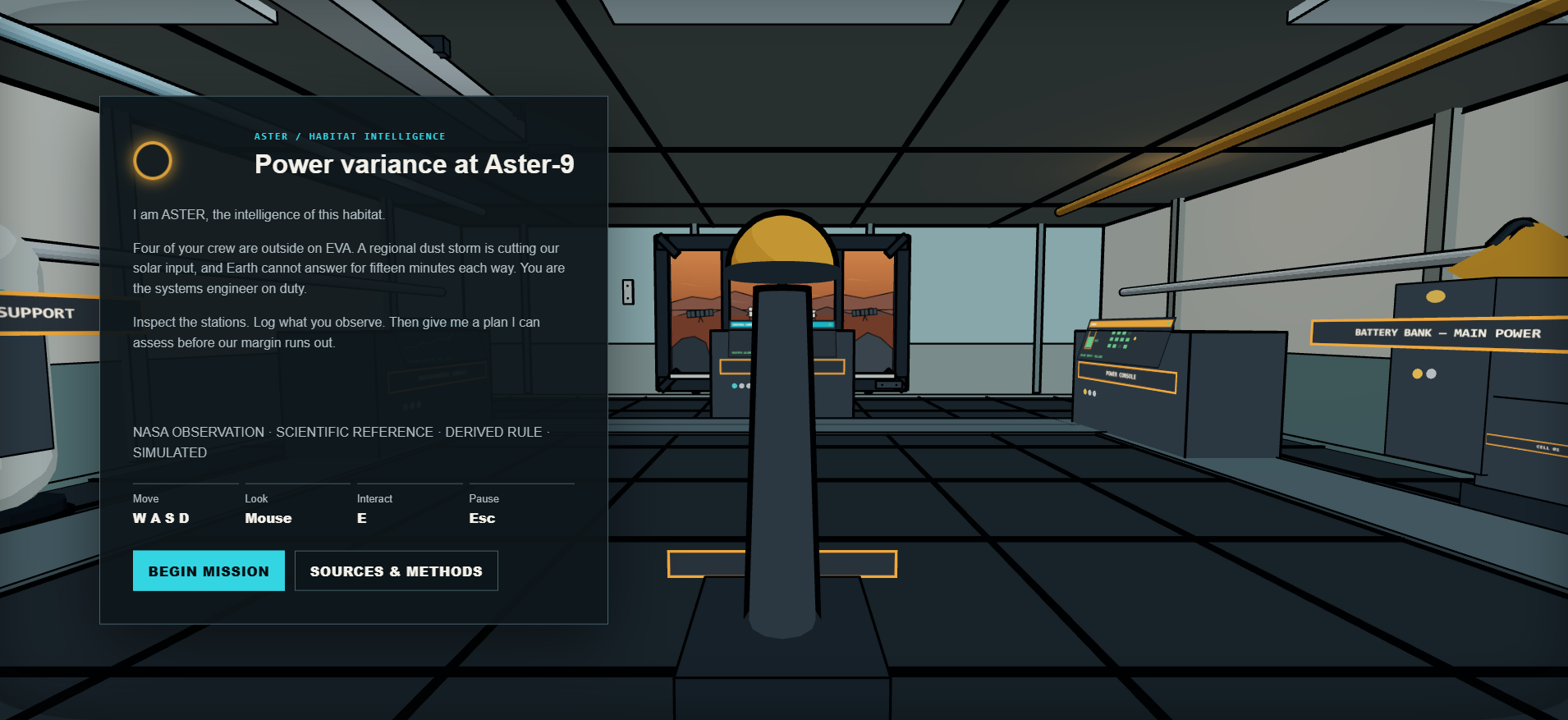
I wanted to make evidence use spatial and consequential. In Signal Delay, the learner is the systems engineer on duty at Aster-9. A dust storm is reducing solar input, four crew members are outside, and a reply from Earth cannot arrive before the habitat's decision window closes.
The learning question was not “Can you find the right answer?” It was “Can you inspect the right evidence, separate observation from simulation, and justify a defensible plan?”
What I Built
The experience is deliberately narrow: one habitat, one dust-and-power scenario, and one complete learning loop. That scope made it possible to design the transitions, recovery states, evidence language, and debrief as one coherent product instead of a collection of disconnected features.
A skippable opening and briefing establish the power variance, the crew on EVA, and the communication delay before controls are introduced.
WASD, mouse-look, readable prompts, pause, pointer-lock release, and position recovery support movement through Environmental, Power, and Communications zones.
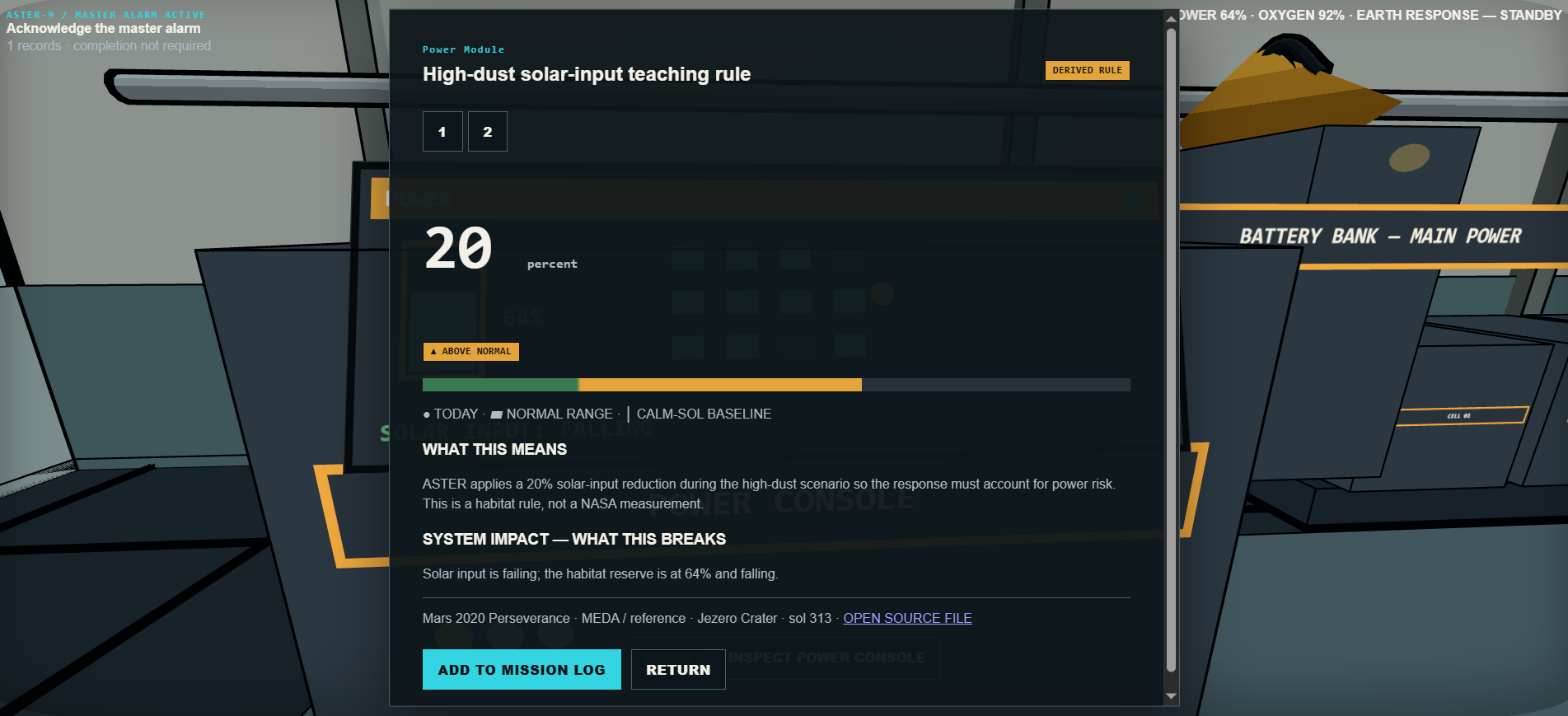
Each console explains what a value means, what system it affects, and whether it is an observation, reference, rule, or simulated condition.
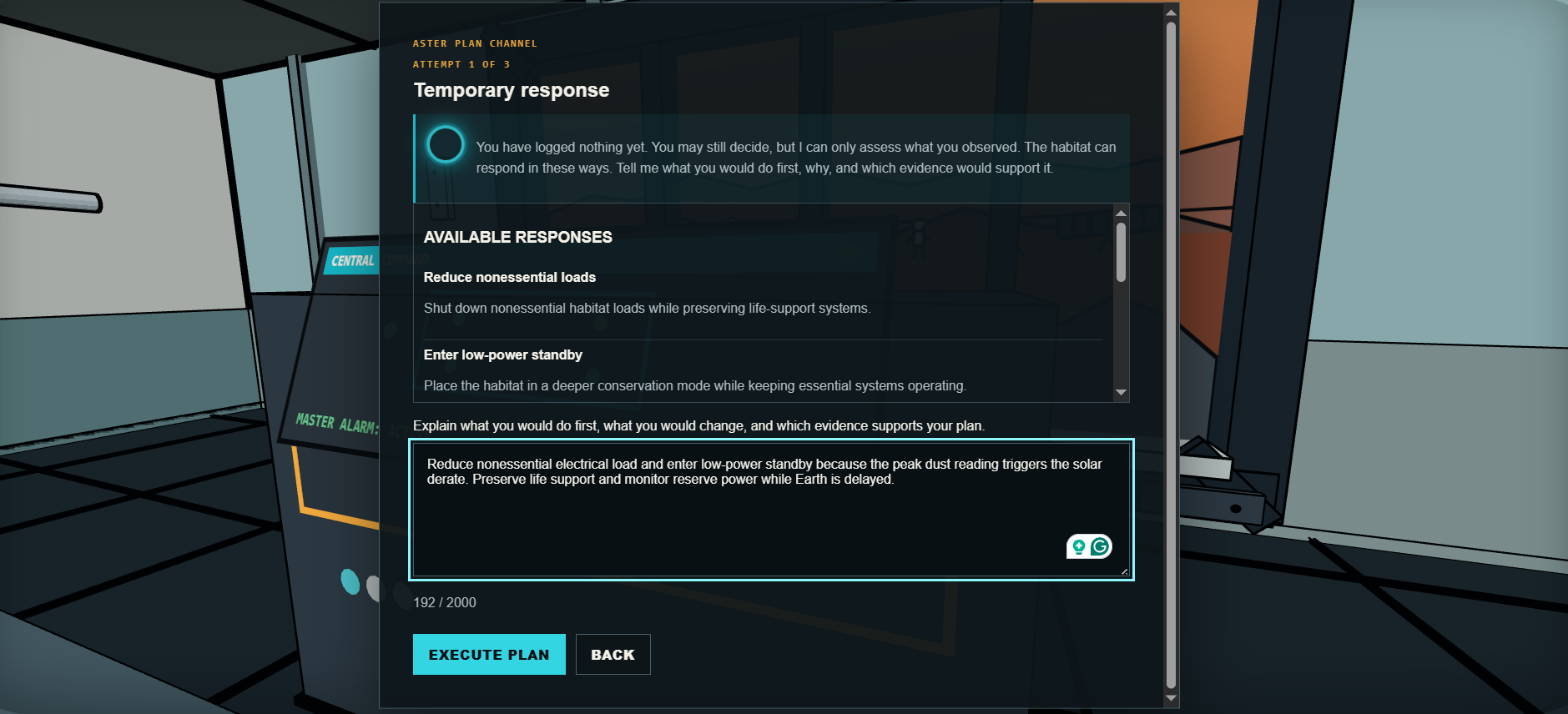
The learner responds in natural language rather than choosing a prewritten answer. The plan must say what to do, why, and which inspected evidence supports it.
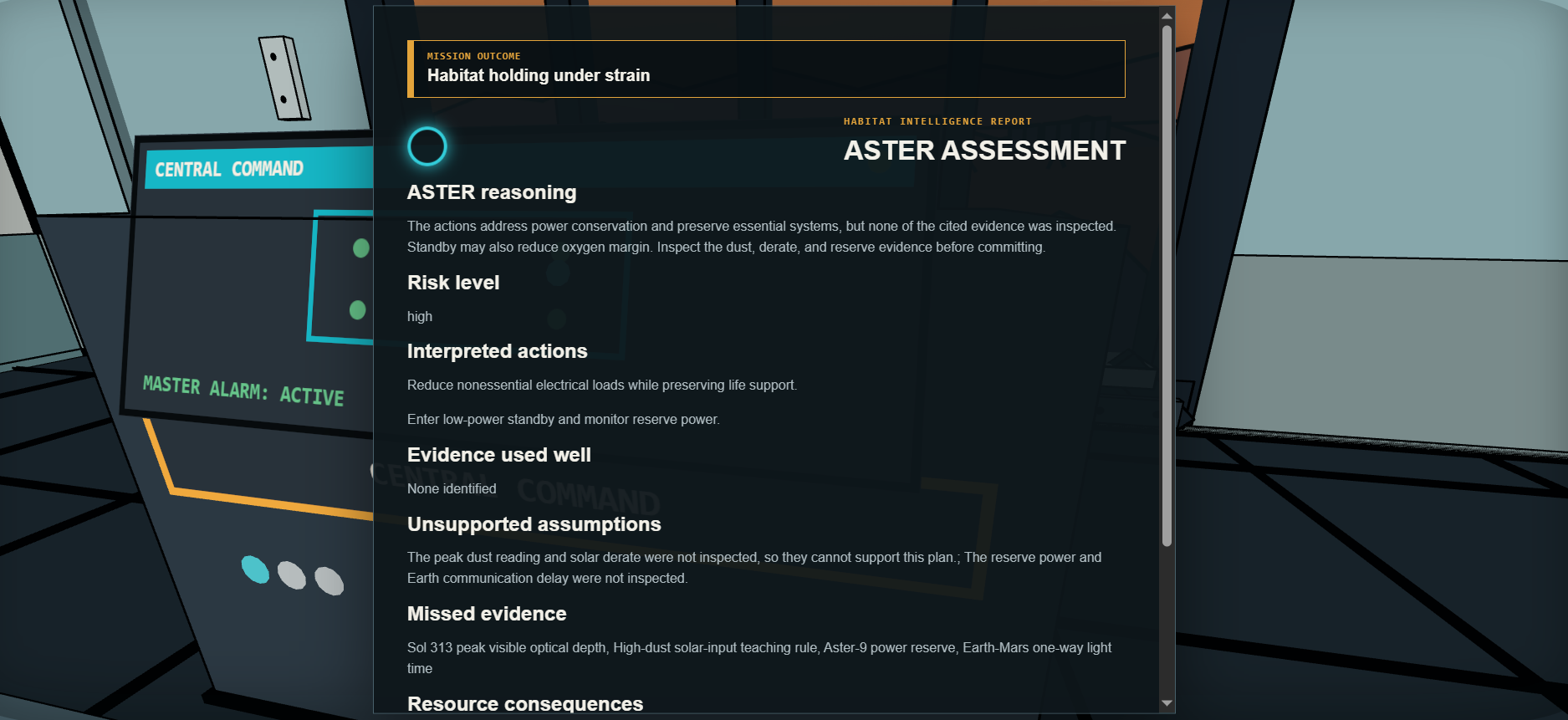
GPT-5.6 returns bounded feedback on interpreted actions, evidence used well, unsupported assumptions, missed evidence, feasibility, risk, and resource consequences.
Sources & Methods exposes provenance, transformations, checksums, truth labels, and AI disclosures instead of hiding the scientific machinery behind the scene.
Evidence Design
The central design decision was to prevent visual realism from turning into scientific overclaiming. The habitat is fictional. Some values are reviewed NASA observations; others are published context, teaching abstractions, or simulated telemetry. The interface labels that difference at the moment a learner uses the value.
Reviewed pressure, air-temperature, and wind values keep source ids, original units, transformations, and checksums.
Optical-depth and communication references are useful scientific context without being misrepresented as direct rows from the MEDA snapshot.
The fictional 20% solar-input derate shapes the decision, but the UI explicitly says it is a habitat teaching rule, not a NASA measurement.
Power, oxygen, crew, and habitat telemetry support the scenario while remaining visibly separate from observed Mars data.
My Role
Signal Delay was built in collaboration with AI; the design decisions, content, and direction are mine. I did not write the project line by line myself. I treated AI collaboration as a production system that needed scopes, evidence, review, and an accountable owner.
I defined the STEM audience, problem, learning goal, scenario, truth model, product scope, visual direction, judging priorities, and acceptance decisions. I reviewed the playable experience and decided what was ready to ship.
Codex implemented the Next.js foundation, deterministic mission contracts, procedural 3D habitat, NASA data pipeline, GPT-5.6 route, tests, documentation, and correction rounds from governed prompts.
Claude helped author execution prompts, independently reviewed implementation rounds, translated findings into correction scopes, and assisted with the final cinematic and E2E stabilization.
GPT-5.6 helped shape early work-package prompts and, inside the product, interprets a learner's plan against a finite trusted evidence pack. It does not control mission state or invent source facts.
The repository preserves canonical prompts, session records, and decision records so the collaboration can be inspected as a process — not accepted as a vague “made with AI” claim.
Design Decisions
A fixed answer would test recognition. A written plan exposes what the learner noticed, assumed, and connected, which gives the debrief something meaningful to evaluate.
The source pipeline is reproducible, but gameplay uses a committed snapshot. A classroom or judge should never lose the mission because an external archive is slow or unavailable.
The habitat, labels, props, materials, and outlines are code-defined. That kept provenance clear and let the visual hierarchy evolve with the evidence interactions instead of around a fixed environment.
I kept accounts, a database, multiplayer, an open world, and extra scenarios out of scope. The priority was a reliable opening-to-debrief loop with recovery and disclosure at every boundary.
The supported path is current desktop Chrome or Edge. Essential evidence is presented in accessible DOM overlays, but full mobile controls were not claimed or rushed into the MVP.
If the provider fails, the learner's plan is preserved and a deterministic learning fallback is clearly labeled. The product never presents fallback text as a successful GPT-5.6 result.
Technical Guardrails
The AI boundary was designed around one rule: the model may interpret language, but it does not get authority over evidence values, legal actions, truth labels, mission phases, or resource bounds.
Only the scenario version, inspected evidence ids, plan text, request id, and limited continuity metadata cross the client boundary.
The route validates origin, shape, and size, then reloads the scenario and evidence from repository-controlled files instead of trusting the browser.
Evaluator instructions, trusted records, and the learner's plan occupy distinct prompt layers. Player text cannot rewrite the evidence pack or output contract.
The Responses API returns a JSON Schema result. Application validation rejects unknown actions, evidence, outcomes, resources, versions, and non-finite values.
The client revalidates the sanitized result before the guarded deterministic reducer can enter the debrief state.
Build Process
The implementation ran from July 16 to July 20, 2026 as a sequence of small work packages: repository and state contracts first, then the 3D slice, NASA evidence pack, exploration loop, GPT evaluation, cinematic/audio, visual fidelity, corrections, and submission documentation.
Each material scope had a preserved prompt, session record, acceptance checks, and decision gate. The default verification path stayed offline: unit, integration, and browser tests used versioned fixtures rather than paid OpenAI or live NASA calls.
Outcome & Reflection
Signal Delay shipped as a free, no-login browser experience with a complete opening-to-debrief loop, traceable scientific sources, recoverable AI failure states, and a public implementation that makes the human–AI workflow reviewable.
The project demonstrates how I connect product framing, content design, interaction, scientific integrity, AI boundaries, and front-end implementation. The strongest lesson was that provenance is not only a data-engineering concern: it changes labels, hierarchy, feedback, and what the interface is ethically allowed to imply.
What this build does not yet prove is learning impact. It has not gone through a formal learner study. The next meaningful step is testing whether students can more accurately distinguish observation, reference, rule, and simulation after the mission — and whether the debrief improves a second decision.
Play the mission in a current desktop Chrome or Edge browser, or inspect the source, evidence methodology, and collaboration record.