Not a CRM
No pipelines, no status stages, no pressure loops. The app avoids the feeling that relationships need to be managed like tasks.
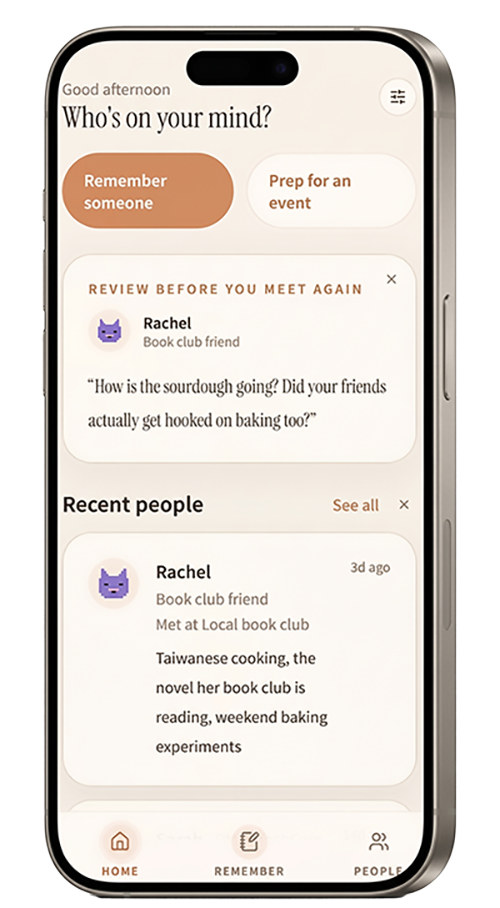
A gentle social memory app for introverts and people who find socializing tiring. Rehello helps them capture the fragments they remember, use GPT-5.6 to shape a messy note into a reviewable recall card, and feel more ready for the next conversation — without the pressure of a CRM.
Next.js 16 · TypeScript · GPT-5.6 · OpenAI Responses API · Zod · PWA


Context
Rehello started from a very different emotional premise than most networking tools. The problem was not "how do I track leads?" It was "how do I remember someone I just met without turning that person into a record?"
I wanted to explore a product that supports social memory for people who feel shy, overwhelmed, or mentally overloaded after meeting someone new. That meant the product needed to feel more like a quiet notebook than a productivity system.
The goal was to help users feel more human and more prepared in future interactions, not more optimized.
Product Framing
Most existing tools assume a transactional mindset: follow-up cadence, pipeline stages, or generic note fields. That felt wrong for this audience. Rehello needed a different product language, different interaction tone, and different priorities.
No pipelines, no status stages, no pressure loops. The app avoids the feeling that relationships need to be managed like tasks.
The first version stays focused on memory support. It helps users remember what matters and gently prepare, without pretending to teach them how to perform socially.
The visual system, copy, and interactions all aim to reduce anxiety. Every surface is meant to feel calm, lightweight, and forgiving.
Saved history stays in the browser. Only an explicit Quick Remember submission sends the current note and a visitor-owned API key through the server to OpenAI for that attempt.
Core Loop
The product is shaped around a simple sequence: capture what you remember, review what matters, and return to it before the next conversation. The newest version supports that loop without forcing every visitor into the same level of effort or API use.
Visitors can explore a fixed demo with no API call, turn their own messy note into a draft with GPT-5.6, or use the original nine-step guided flow one question at a time.
Quick Remember returns seven structured fields, but nothing is saved automatically. The user reviews the card, adjusts anything that feels wrong, and then chooses whether to keep it locally.
Person profiles, recall cards, Prep prompts, and in-app reminders bring useful context back at the right moment. No streaks, no scores, and no guilt-driven notifications.
Key Decisions
A ready-made result proves the value without an account, key, or API charge. Users who want more control can choose Quick Remember or the original guided prompts.
People, encounters, reminders, Prep topics, and demo data stay in browser storage. The interface explicitly explains that a real Quick Remember request sends only the current note and one-time key through the server to OpenAI.
GPT-5.6 does one visible task: transform a 20–1,200 character note into a seven-field draft. Structured output constrains the shape, while the prompt tells the model not to invent facts or infer sensitive traits.
Generated drafts can still be incomplete or wrong. Rehello makes the result editable and requires a deliberate save, keeping the user — not the model — responsible for the personal record.
System Thinking
Although the app is small, a lot of product work lived in the system details: how people sort, how reminders surface, how backup and restore behave, how demo data stays separate from paid API use, and how a one-time API key is cleared after an attempt.
I also treated the phone-sized shell as a shared system rather than a collection of individual pages. Stabilizing dynamic viewport height, safe-area behavior, horizontal containment, and bottom navigation made the experience more dependable across routes and narrow mobile widths.
The UX promise depends on more than warm visuals. The storage model, AI boundary, review step, and mobile shell all need to tell the same story: calm, explicit, and under the user's control.
What I Built
store: false, and returns no-store responsesAI in Product & Process
In the product, GPT-5.6 performs one bounded transformation: messy post-conversation note to structured recall-card draft. The server uses the OpenAI Responses API, low reasoning effort, strict structured output, and store: false. The generated card is always reviewed before it becomes a saved memory.
In the process, I used AI as a rapid product-building partner across naming, framing, front-end implementation, debugging, testing, and documentation. It accelerated execution, but it did not define the product point of view.
Current Boundaries
Reflection
Rehello shows how I think about product design beyond screens. The work spans category framing, interaction language, a visible but bounded AI role, privacy communication, responsive behavior, testing, and the judgment required to make a small system feel emotionally coherent.
The next meaningful step is still real-user testing: learning whether the capture-review-recall loop genuinely reduces anxiety before social re-encounters. The live MVP already demonstrates a strong point of view, but the most important outcome will be whether that point of view helps people in practice.