Concept and creative direction
I framed the project as an interactive mythology atlas and set the overall tone: atmospheric, comparative, and culturally specific rather than fantasy-generic.
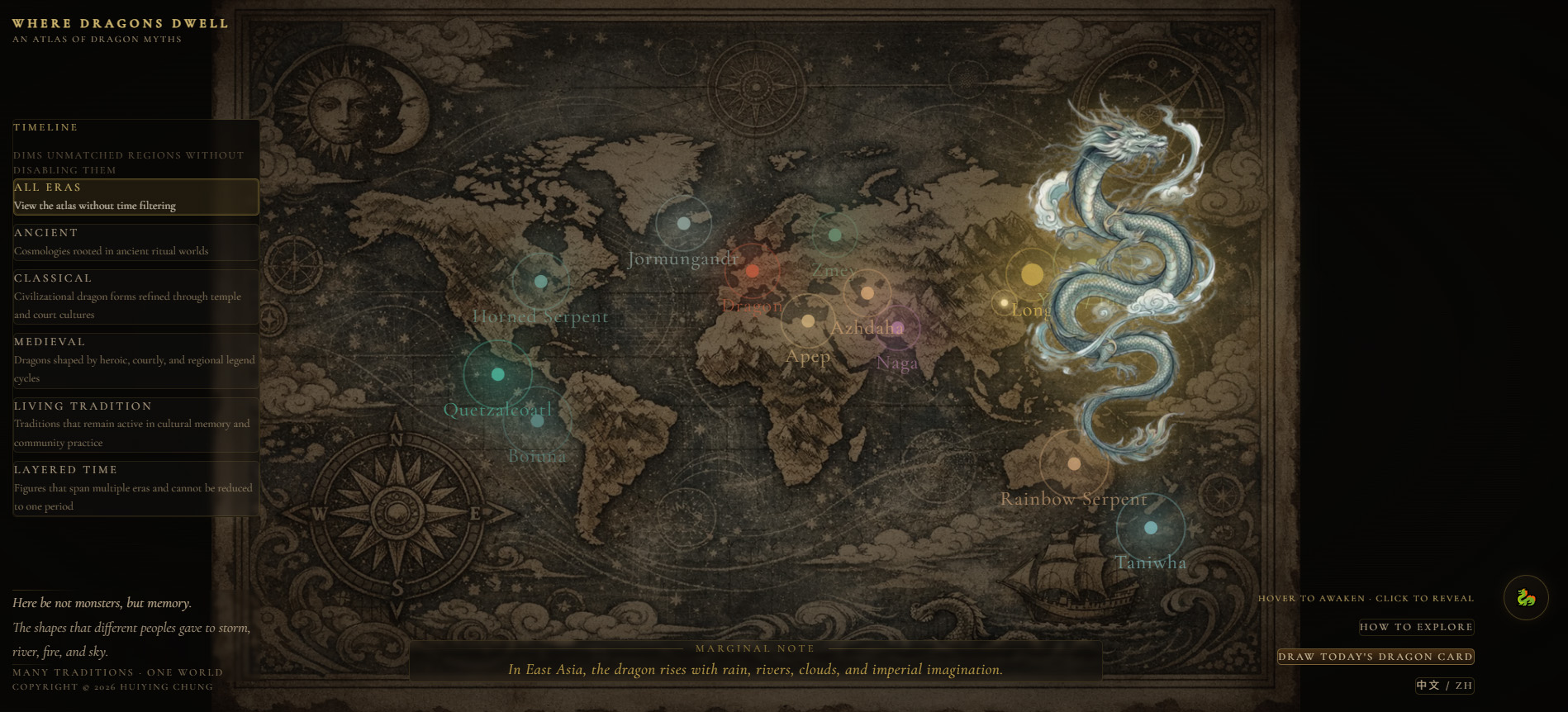
An open-source interactive mythology atlas exploring dragon traditions across 14 world cultures through map exploration, timeline filtering, side-by-side comparison, daily keepsake cards, and an AI Oracle grounded in verified sources.
Interactive Atlas · Mythology Curation · AI Oracle · Comparative UX · Portfolio Project
Project Summary
Where Dragons Dwell began with a simple idea: a world dragon map. But that framing quickly felt too shallow. Without a stronger concept, the project risked becoming either a decorative fantasy map or a set of trivia markers on a globe.
The project became more meaningful once I reframed it as a curated mythology atlas. That shift changed the goal from showing dragons as one universal creature to revealing how different cultures imagined dragon-like beings through geography, belief, symbolism, and cultural memory.
The core question became: what if a world map could reveal not one universal dragon, but many distinct cultural visions of dragon-like beings?
My Role
I did not write this project line by line myself. My role was to define the core idea, shape the experience, curate the featured traditions, decide what features mattered, and keep the work aligned with a digital-exhibition feel rather than a generic content site.
I framed the project as an interactive mythology atlas and set the overall tone: atmospheric, comparative, and culturally specific rather than fantasy-generic.
I selected the traditions, shaped the content hierarchy, and decided how much information should live in cards, filters, comparisons, and follow-up interactions.
I chose the timeline filter, side-by-side comparison, AI Oracle, and daily keepsake card because each one supported interpretation without overwhelming the main interface.
Codex and Claude Code helped build the working experience. I used them as implementation collaborators while staying responsible for the design judgment and final direction.
Goal
I wanted the project to feel closer to a curated exhibition than a reference website. That meant balancing atmosphere, interpretation, and interactivity without turning the interface into a dense mythology database.
Challenge
The hardest design problem was not just making the atlas beautiful. It was making traditions feel culturally distinct while still belonging to one coherent interactive system.
A Chinese Long, a South Asian Naga, Quetzalcoatl, Jormungandr, Apep, Boiuna, and the Rainbow Serpent should not feel like small variations of the same fantasy beast. Their symbolism, mood, and narrative framing all needed to stay specific while still fitting within one atlas.
If the interface carried all the educational depth directly, the project would lose its exhibition quality and become heavy to browse.
If I focused only on atmosphere, the site would stop teaching anything meaningful about cultural difference.
The most important tension was between consistency and difference: one atlas, but many culturally distinct mythic forms.
Curatorial Approach
I approached the site as a layered experience. The map became the stage, and each interaction layer added depth without requiring the interface to become crowded.
The world map acts as the main point of discovery, turning geography into a way of entering different symbolic worlds.
I selected 14 traditions for contrast, symbolic range, and global spread, rather than trying to build an exhaustive dragon encyclopedia.
Timeline filtering, side-by-side comparison, the AI Oracle, and the daily keepsake card all extend interpretation while keeping the main interface visually focused.
Featured Traditions
I chose traditions that reveal how differently cultures imagined powerful serpent and dragon-like beings, from rain and kingship to creation, apocalypse, sacred protection, and cosmic threat.
Long · Ryu · Yong / Imugi · Naga · Quetzalcoatl · Boiuna · Horned Serpent · European Dragon · Jormungandr · Zmey · Apep · Aži Dahāka · Rainbow Serpent · Taniwha
Key Features
The map gives the project its exhibition framing. It positions each tradition within a global network of mythic imagination instead of isolating entries as standalone facts.
The timeline adds historical interpretation through categories like Ancient, Classical, Medieval, Living Tradition, and Layered Time.
Comparison is the clearest way to show that these beings are not one monster type, but many distinct cultural forms shaped by different worldviews.
The Oracle answers follow-up questions about symbolism and cross-cultural patterns. Its prompt embeds a digest generated from the atlas's own source-checked entries, so it answers from the curation itself and declines questions beyond it.
One printable daily draw turns the project into more than browsing. It adds ritual, revisit value, and a small curatorial artifact users can keep.
Design Decisions
Each tradition needed its own atmosphere and symbolic identity. Long could not read like Apep, and Quetzalcoatl could not drift into a medieval dragon silhouette.
I intentionally limited the atlas to 14 traditions so each one could carry more weight and the experience would stay readable.
The Oracle exists because it extends comparison and symbolic inquiry. It is part of the concept, not a trend-driven add-on.
I chose one keepsake card per day instead of unlimited draws so the interaction would feel memorable and collectible rather than game-like.
Reliability & Open Source
After the initial release, I took the project through a reliability and open-source pass. A site that presents cultural traditions carries a responsibility that a fantasy project does not: the content has to hold up to checking.
Every tradition now carries real, checkable sources — primary texts, scholarship, and museum resources, 46 in total — each verified against a live URL or a standard published edition, and shown directly on entry pages.
All 14 entries were reviewed against those sources. That pass renamed the Persian dragon to its specific Avestan figure Aži Dahāka, correctly attributed taniwha to Māori tradition, and named nation-specific horned serpents instead of flattening them into one myth.
The Oracle's knowledge is generated from the same data files that render the site, with explicit rules to decline questions the atlas cannot support — so the AI can never know more than the curation does.
The project is public on GitHub with a clean, reviewable history: MIT for the code, CC BY 4.0 for the atlas content and imagery (with AI-image provenance notes), plus CI that lints, typechecks, and builds every change.
AI Collaboration
This project reflects how I like to work with AI: not as a substitute for authorship, but as a tool for implementation, iteration, and translation from concept to execution.
Outcome
Where Dragons Dwell started as an idea about dragons, but it became a project about cultural imagination. The final result is a portfolio-quality interactive atlas that combines curation, comparative interaction, and AI-assisted exploration.
What makes the project meaningful to me is the shift from "dragon content" to a curated mythology experience that invites users to compare, question, and read traditions as distinct forms of mythic thought.
Visit the interactive site to experience the world map, timeline, Oracle, and daily dragon card — or read the code and sources on GitHub.